
10 Best Luxury Safari Lodges & Camps in Uganda
September 14, 2026
AFCON 2027 East Africa Travel Guide: Football, Gorilla Trekking and Safaris
October 18, 2026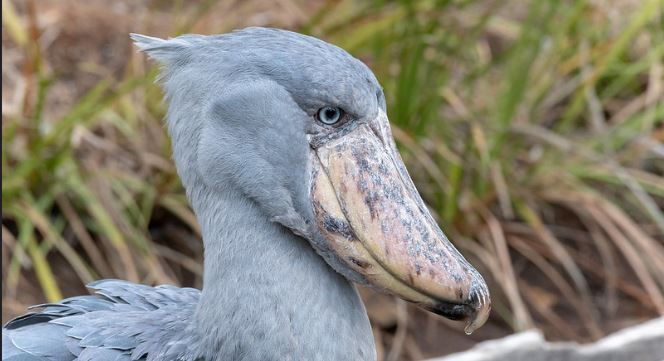
Birding in Uganda: Africa’s Greatest Birdwatching Destination
There is a particular kind of silence that falls over a serious birdwatcher the moment they first check Uganda’s species tally: over 1,080 recorded bird species, more than half of all birds found across the entire African continent packed into a country you can drive across in a single day. For the birding community, Uganda is not just a destination. It is a pilgrimage. Whether you have been ticking birds for decades or you are just beginning to notice the world above eye level, Uganda will stop you in your tracks.
The reason for this extraordinary diversity comes down to geography. Uganda sits at the crossroads of East and Central Africa, where the open savannas of the east meet the vast Congo Basin rainforests of the west, and the Great Rift Valley wetlands run through the middle. Add montane forests, papyrus swamps, volcanic highlands, and the shoreline of Lake Victoria — Africa’s largest lake and you have an ecosystem mosaic that supports birds found nowhere else on earth. This is the story of Uganda’s birds, where to find them, and why no serious birder should leave this continent without coming here first.
Why Uganda is Africa’s Top Birding Destination
Most birding destinations in Africa excel in one ecosystem. Uganda excels in all of them simultaneously. It holds more bird species than Kenya, more than Tanzania, more than South Africa. The numbers alone are remarkable but what makes Uganda truly special for serious birders is the concentration of rare, endemic, and hard-to-find species in a relatively small area.
The Albertine Rift (the western arm of Africa’s Great Rift Valley) — runs through western Uganda, and this ancient geological feature has acted as an evolutionary incubator for thousands of years, producing species found nowhere else on the planet. Uganda holds 23 Albertine Rift endemic bird species, more than any other single country in the rift. Bwindi Impenetrable Forest alone shelters 14 of these endemics, making it the number-one birding hotspot in the entire rift and, many ornithologists argue, in all of Africa.
Uganda also benefits from the wet season, when migratory species from Europe and the Palearctic region arrive in winter in the country’s wetlands and forests, temporarily swelling the already extraordinary species count even further. Year-round, the birding is exceptional. During the wet months of March to May and October to November, it becomes almost overwhelming.
Uganda’s Most Iconic Bird Species
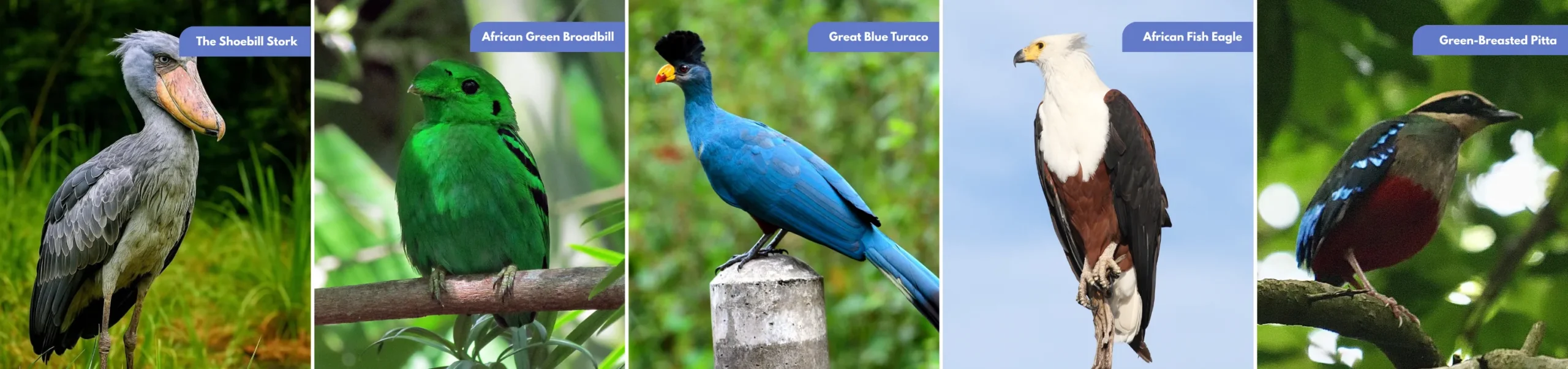
► The Shoebill Stork · Balaeniceps rex — IUCN Vulnerable
No bird in Uganda generates more excitement or more devoted pursuit than the Shoebill. This extraordinary prehistoric-looking waterbird, standing over a metre tall with a bill resembling a Dutch wooden clog, is one of the most sought-after species in the world. It moves with an almost reptilian slowness, standing motionless in papyrus swamps for long periods before striking at lungfish with devastating speed. Uganda holds one of the largest populations of Shoebill on earth, and Mabamba Swamp on the shores of Lake Victoria just an hour from Entebbe is the single most reliable place to find one. Early-morning canoe trips through the papyrus channels bring visitors face-to-face with this ancient creature in a setting that feels entirely other-worldly.
► African Green Broadbill · Pseudocalyptomena graueri — Bwindi’s rarest jewel
Among serious tickers, the African Green Broadbill represents one of the great East African ‘megas’, a tiny, emerald-green forest bird of the Albertine Rift endemics found almost exclusively in Bwindi Impenetrable Forest. It inhabits dense montane forest understorey and is notoriously difficult to see well. Guides at Bwindi know exactly where to look, and the patience required to find one only deepens the reward when it finally appears, glowing green in a shaft of forest light. This bird alone motivates dedicated birders to make the journey to Bwindi.
► Great Blue Turaco · Corythaeola cristata — the jewel of the canopy
The Great Blue Turaco is Uganda’s most visually spectacular common bird, a large, turquoise and yellow canopy species found in forested areas across the country, from Kibale and Bwindi to Semuliki. It moves through the treetops with a loping, almost comical gait, and its call a deep, resonant drumming carries across long distances in the forest. In the morning light filtering through the Kibale canopy, a Great Blue Turaco in full view is one of the genuinely beautiful wildlife moments Uganda offers.
► African Fish Eagle · Haliaeetus vocifer — voice of the African wilderness
The call of the African Fish Eagle: a wild, carrying, downward-spiraling cry is one of the defining sounds of Uganda’s lakes and rivers. From Lake Victoria to the shores of the Kazinga Channel in Queen Elizabeth National Park, this magnificent raptor perches high on dead trees above the water, dropping in steep, talons-first dives to pluck fish from the surface. Few birds anywhere in the world have a call as immediately recognizable or as evocative as this one.
► Green-Breasted Pitta · Pitta reichenowi — the holy grail of Kibale
The Green-breasted Pitta is, for many birders, the single most desired species in Uganda. A skulking, jewel-coloured forest floor bird, it is notoriously secretive and extremely difficult to locate even when calling. Kibale National Park holds the most reliable population in Uganda, and sightings when they happen are genuinely memorable. Expert guides at Kibale know the territories well. Finding one requires patience, skill, and more than a little luck. Which is, of course, precisely what makes it so rewarding.
Birding in Uganda – Firante Gorilla Trekks
Top Birding Destinations in Uganda
- Bwindi Impenetrable Forest· 350+ species · 23 Albertine Rift endemics
Voted the number-one birding hotspot in Africa by multiple ornithological organisations, Bwindi earns this title through sheer concentration of rare and endemic forest birds. The Ruhija sector is particularly productive, with the Mubwindi Swamp trail consistently delivering Green Broadbill, Grauer’s Swamp Warbler, Shelley’s Crimsonwing, Bar-tailed Trogon, and Black-billed Turaco. Combine gorilla trekking with a birding extension here and you experience two of East Africa’s greatest wildlife encounters in the same forest, a combination offered through Firante Gorilla Treks’ Bwindi packages.
Don’t miss: African Green Broadbill, Rwenzori Turaco, Short-tailed Warbler, African Hill Mynah
- Queen Elizabeth National Park· 600+ species — Uganda’s most diverse park
With over 600 recorded species across multiple habitats, savanna, forest, wetland, and the Kazinga Channel waterway — Queen Elizabeth National Park is Uganda’s most species-rich birding destination. The Kazinga Channel boat safari is particularly productive for waterbirds: African Skimmer, Pink-backed Pelican, Malachite Kingfisher, Pied Kingfisher, Yellow-billed Stork, and African Fish Eagle are all reliably seen. The Maramagambo Forest in the south holds forest specials, while the Ishasha sector adds savanna birds including the Blue-throated Roller and Flappet Lark.
Don’t miss: African Skimmer, Martial Eagle, Grey-headed Kingfisher, African Fish Eagle, Shoebill (rare but recorded)
- Mabamba Swamp· 260+ species · Uganda’s best Shoebill site
Mabamba Swamp on the western shore of Lake Victoria, just 57 kilometres from Kampala is the single most reliable place in Uganda, and arguably in the world, to see the Shoebill in the wild. Early-morning canoe trips through the papyrus channels are the method: a knowledgeable local guide poles you silently through the swamp while you scan the vegetation for that unmistakable silhouette. The swamp also holds Papyrus Gonolek, Blue-headed Coucal, Lesser Jacana, and Malachite Kingfisher in good numbers.
Don’t miss: Shoebill Stork, Papyrus Gonolek, African Jacana, Blue-headed Coucal, Malachite Kingfisher
- Kibale Forest & Bigodi Wetland· 375+ species · Green-breasted Pitta
Kibale is world-famous as the best place in Africa to track chimpanzees but birders know it equally well as one of Uganda’s premier forest birding sites. The forest holds over 375 species, including six Albertine Rift endemics. The Bigodi Wetland Sanctuary, a community-run conservation area adjacent to the park, adds over 134 additional species including White-spotted Flufftail, Speckle-breasted Woodpecker, Bocage’s Bushshrike, and the Great Blue Turaco in brilliant canopy light.
Don’t miss: Green-breasted Pitta, Black Bee-eater, Great Blue Turaco, African Pitta, Yellow-billed Barbet
- Semuliki National Park· Uganda’s Congo Basin gateway
Semuliki, in western Uganda near the Congo border, is the country’s most specialist birding destination — a lowland rainforest that extends the Congo Basin biome into Uganda and holds species found nowhere else in East Africa. The Sempaya hot springs trail is renowned for producing Congo Basin specials: Nkulengu Rail, Black-wattled Hornbill, Yellow-throated Cuckoo, and African Piculet. For serious tickers adding to an East African list, Semuliki delivers species impossible to find anywhere else in the region.
Don’t miss: Nkulengu Rail, Black-wattled Hornbill, African Piculet, Yellow-throated Cuckoo, Hartlaub’s Duck
- Kidepo Valley National Park· 470+ species · Ostriches and Northern Rarities
Uganda’s most remote national park — four to five hours from Kampala on roads that become tracks — Kidepo Valley holds over 470 bird species, including many found only in the semi-arid north: Ostrich, Karamoja Apalis (found almost nowhere else), Secretary Bird, Abyssinian Roller, Red-throated Bee-eater, and the spectacular Abyssinian Ground Hornbill. For birders willing to make the journey (a domestic flight via AeroLink is the smart option), Kidepo is genuinely one of East Africa’s great off-the-beaten-path birding destinations.
Don’t miss: Karamoja Apalis, Ostrich, Secretary Bird, Abyssinian Ground Hornbill, Red-throated Bee-eater
- Murchison Falls National Park· 450+ species · Nile waterbirds
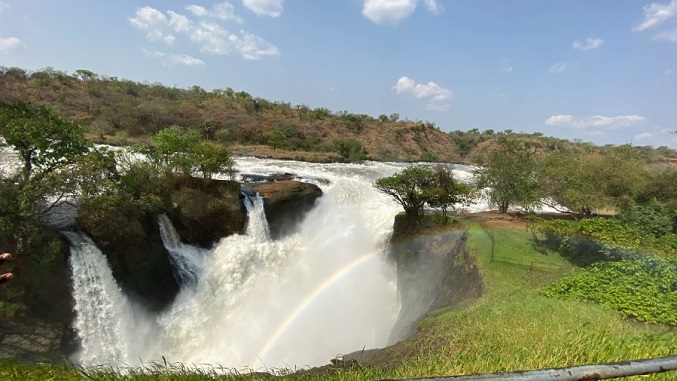
Uganda’s largest national park combines riverine forest, open savanna, and the Victoria Nile to produce a bird list of over 450 species. The river itself is the centrepiece for birders: boat safaris from Paraa to the base of Murchison Falls regularly produce Shoebill (in the delta area), Goliath Heron, African Fish Eagle, Rock Pratincole, and enormous congregations of Red-throated Bee-eaters nesting in the river bank. The Shoebill can also be seen at the Nile delta by dedicated searchers.
Don’t miss: Shoebill (Nile delta), Goliath Heron, Abyssinian Ground Hornbill, Red-throated Bee-eater, Rock Pratincole
Best Time for Birding in Uganda
Wet season (March–May and October–November): The best birding months. Resident birds are in breeding plumage, migratory Palearctic species have arrived to winter in Uganda’s wetlands and forests, and the vegetation is lush and green. Forest birds are more vocal and active. The trade-off is occasional rain and muddier trails — but for birders, the reward far outweighs the inconvenience.
Dry season (June–September and December–February): Excellent for combining birding with gorilla trekking and big-game safaris. Trails are easier, skies are clearer for photography, and wetland species concentrate around water sources. The overall variety is slightly lower without the migratory visitors, but the quality of sightings is often higher due to better visibility.
For most first-time birding visitors, the October–November window offers an outstanding combination: end of the rains, migratory species still present, and lodge availability is good without peak-season permit pressure.
Planning Your Uganda Birding Safari
Uganda birding works best when paired with a wider safari itinerary — combining target species with gorilla trekking in Bwindi, chimpanzee tracking in Kibale, and game drives in Queen Elizabeth or Murchison Falls. Firante Gorilla Treks offers Uganda safari packages that can be extended or customised to incorporate dedicated birding time at every destination, with experienced local bird guides arranged alongside the standard wildlife activities.
Suggested packages for birders:
- 5 Days Uganda Primate Tracking Safari (Kibale + Bwindi) — From $2,080
- 7 Days Uganda Primates & Game Drives — From $3,030
- 8 Days Best of Western Uganda Tour — From $3,000
- Browse All Uganda Safari Packages
For specialist birding extensions — dedicated days at Mabamba Swamp, Semuliki, or Ruhija (Bwindi) — contact Firante directly to build a customised itinerary around your target species list.
Plan Your Uganda Birding Safari
Firante Gorilla Treks | www.firantegorillatreks.com | Email: info@firantegorillatreks.com | WhatsApp: +256 731 160015 / +256 760 977597 | All Links